Complex · Commerce
Sneakers First, for Sneaker Fans
A commerce-only test of whether sneaker-interest signals could make the existing Complex Shop homepage more relevant without rebuilding its structure
- Owned
- originated the experiment and owned its eCommerce/homepage expression; the eCommerce team built the merchandising and content experience within a shared audience effort
June 2026 experiment
Homepage comparison
Control / Variation B
Control current layout
Variation B sneakers elevated
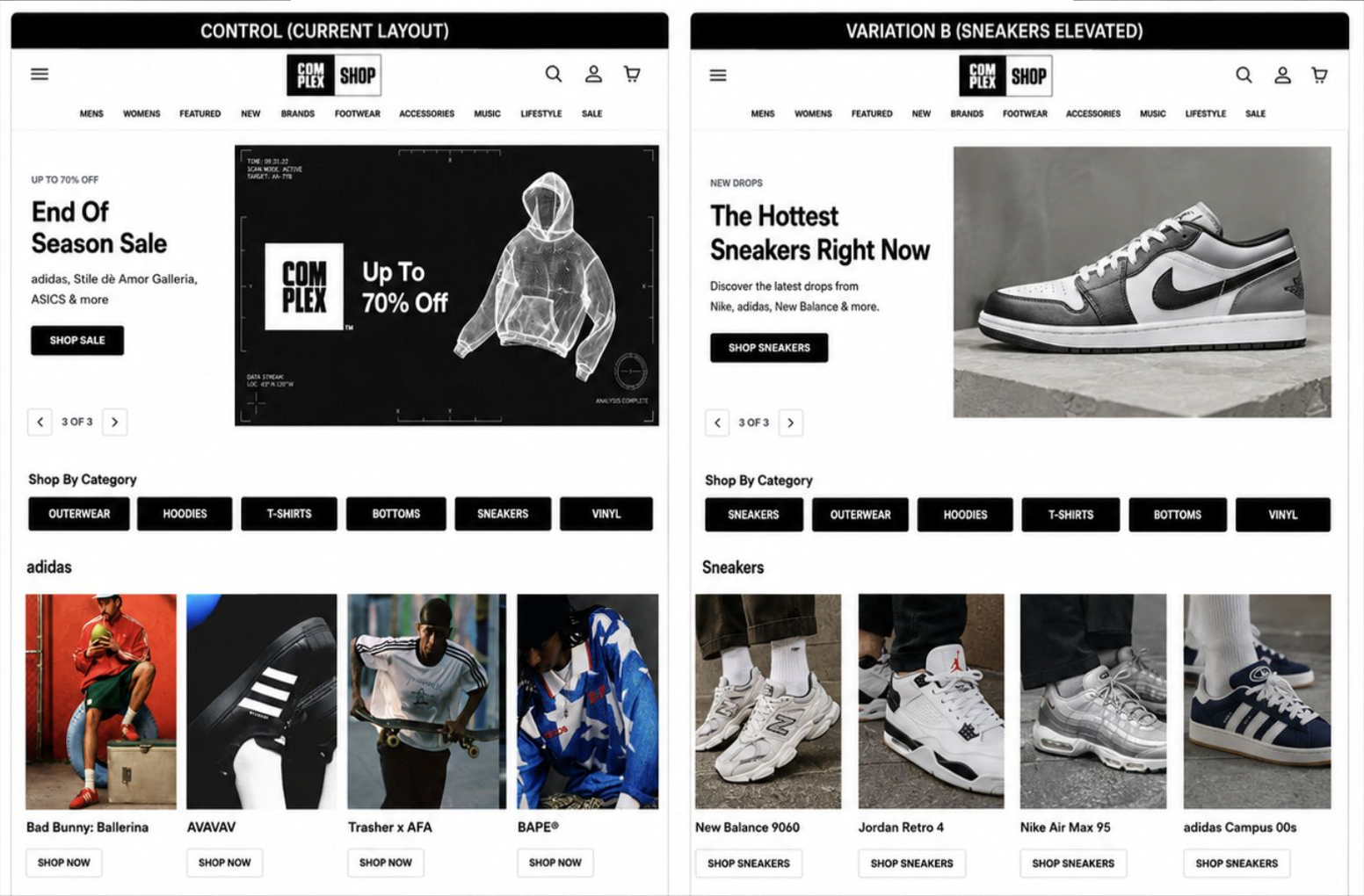
Control versus sneakers-elevated homepage design comparison.
Planning-deck comparison, not a production-site screenshot or independent proof of result.
Provenance — page 5 of the internal planning deck.
Reported outcomeThe sneaker-focused homepage outperformed the control on four reported KPIs: click-through, Add to Bag, conversion, and scroll depth.
Chronicle
One homepage for every visitor
Before this test, the Shop homepage on `www.complex.com/shop` offered the same broad mix to everyone. A visitor could have spent years reading Complex's sneaker coverage or have no history with it at all; either way, the commerce experience opened with one arrangement of categories, brands, artists, products, and stories.
That is the baseline as I remember it. The test stayed inside commerce; it did not personalize the editorial site.
I thought the homepage could make a more useful first decision. If Complex had a bounded signal that someone cared about sneakers, Shop could begin with sneakers rather than asking that person to find their way through a general storefront.
From “renting” an audience to using what Complex knew
The experiment grew from a shared Audience Task Force. Our recurring concern was that Complex was good at finding audiences on other platforms — in our shorthand, “renting” them — but was doing less with what it knew when those people arrived on an experience Complex controlled.
The group extended beyond commerce. I worked alongside the Chief Business Officer, Head of Audience/Growth, Senior Director of Marketing, and VP of Business Operations. The larger audience and personalization initiative belonged to that shared effort. My part was to turn the idea into something executable on the Shop homepage.
The question I owned was a commerce one: what different experience should a person receive once an audience signal was available? The audience cohorts and the experimentation infrastructure underneath the test belonged to the technical and audience teams.
First week of June 2026 — choose one executable experiment
Planning began in the first week of June 2026. I originated the experiment idea, developed the plan and a set of options, and the group aligned on one bounded test: keep the standard Shop homepage as the control and build one sneaker-focused variation for a sneaker-interested audience.
The in-house cohorts we intended to use were not yet directly usable, so the test used Segment audiences as a proxy. The supported audience logic was deliberately limited. Signals included two or more sneaker-related editorial, product-listing, product-detail, or related views and/or membership in a specified sneaker-focused Facebook campaign audience. I pressed on whether the audience was trustworthy and sufficiently large, but I did not create the cohort.
This was not the whole personalization strategy in miniature. It was one experiment we could actually run: one audience, one control, and one meaningful alternate homepage.
Second week of June 2026 — re-merchandise the same structure
The variation did not require a new wireframe. It used the same fundamental homepage structure, then changed what that structure carried.
The control remained the standard broad Shop mix. In the sneaker-focused version, the hero changed. Footwear moved forward in the category order. The product assortment, imagery, content, brand emphasis, and links were replaced or redirected toward sneakers. A visitor moved through the same kind of page, but almost every merchandising decision on it now answered a different interest.
I owned that control-versus-variant expression, and my team implemented the merchandising and content experience in Sanity. The technical team activated the experiment and audience delivery.
Approximately 30 days — run and monitor
The test launched in the second week of June 2026 and ran for approximately 30 days. Segment supported the proxy audience and delivery, Sanity held the two homepage expressions, and Amplitude was part of how performance was monitored; I did not configure each of those tools myself.
We were looking for movement in click-through, scroll depth, Add to Bag, conversion, and reduced bounce rate. I participated in reviewing how the cohort was behaving and in decisions about how performance should inform experience allocation, while the underlying experimentation mechanics remained with the technical and audience teams.
The point of the month was practical: see whether a different arrangement of the same homepage could produce a meaningfully different response from a bounded audience.
August 10, 2026 — reported lift and what it opened
The reported experiment results were 71% higher click-through, 51% higher Add to Bag, 52% higher conversion, and 66% higher scroll depth for the sneaker-focused experience relative to the control.
Those are the relative improvements as I reported them, not a reconstructed statistical analysis.
We considered the experiment successful. What it represented to me was not a finished personalization system; it was a practical indication that we could take one audience signal, change the merchandising rather than rebuild the page, and make the Shop experience more relevant to the person arriving.
It was a first test, not a rollout. The result opened broader conversations about bringing the same kind of audience-aware experience to editorial and other Complex surfaces.