adamshupe.com · Archive
Making Nineteen Records Legible
How I stepped back from a fast-growing personal archive, clarified its chronology and paths through the work, and made it coherent enough to keep growing.
- Owned
- Product and editorial direction; agents and tools assisted with execution
August 12–23, 2026 · post-launch archive maturation through nineteen Published Records
Chronicle
Near enough to twenty
Stage 1 ended with three Published Records. After launch, I returned to significance-first production and kept adding subjects because they were worth preserving, not because the archive needed to reach a quota. The public body of work grew quickly.
I had already set a checkpoint around twenty Records to reconsider the structure. It was not a promise that twenty was ideal or a warning that the archive would fail there. It was simply far enough beyond the initial set that I expected the whole to reveal needs that three Records could not.
By seventeen, the useful signal was simply scale. Nothing had broken, and the archive had not become unusable. I had been focused on producing Records; I chose to pause long enough to see what their accumulation now required.
Make the archive tell the truth once
The first need was not a more elaborate surface. Before deciding how the archive should look, I wanted its shared facts to tell the truth once. Each Record could keep its own story, Evidence, and shape; identity, dates, publication details, and connections across the archive needed a reliable common source.
I directed a small, file-based ledger to hold those shared facts. It kept event dates separate from publication dates and allowed partial or overlapping timelines to remain honest instead of forcing them into false precision. The order in which Records appeared could now be presented without pretending it proved what happened first.
The separation mattered as much as the ledger itself. Claims, Evidence choices, source history, rights, and presentation stayed with each Record. Possible relationships could be remembered without being shown as facts, and I chose to strengthen the private source archive's durability. Once an existing discovery path began reading its shared facts from the ledger, those facts no longer had to be maintained in multiple places.
I chose a checked-in ledger instead of a CMS or database, and held back search, elaborate classification, and a relationship graph. At this scale, the archive needed a dependable foundation, not a platform for administering itself.
Resume before reshaping
With that foundation in place, I resumed production. The sequence mattered: structure was there to support the archive's growth, not replace it. PS Reserve and ComplexCon became Published Records eighteen and nineteen.
Nineteen became the practical point for the broader reassessment. It was near the range I had planned for, but it did not become a rule about how many Records an archive should contain. The individual Records still stood on their own. The question was how a visitor could understand them as one body of work.
The existing chronological list still worked, but one page was carrying two responsibilities: introducing the work selectively and representing the complete Published archive. As the corpus grew across different organizations, eras, and kinds of work, those were no longer the same editorial job. The distinction was worth making; it was not evidence of a failed archive or a measured reader crisis.
Give each path one job
I gave those responsibilities separate homes. Home became a curated introduction: six Records chosen to give a first-time visitor a useful way into the work. Archive became the complete Published body, with every Record appearing once in the chronology. New work would join Archive when it published, while Home would remain deliberately chosen.
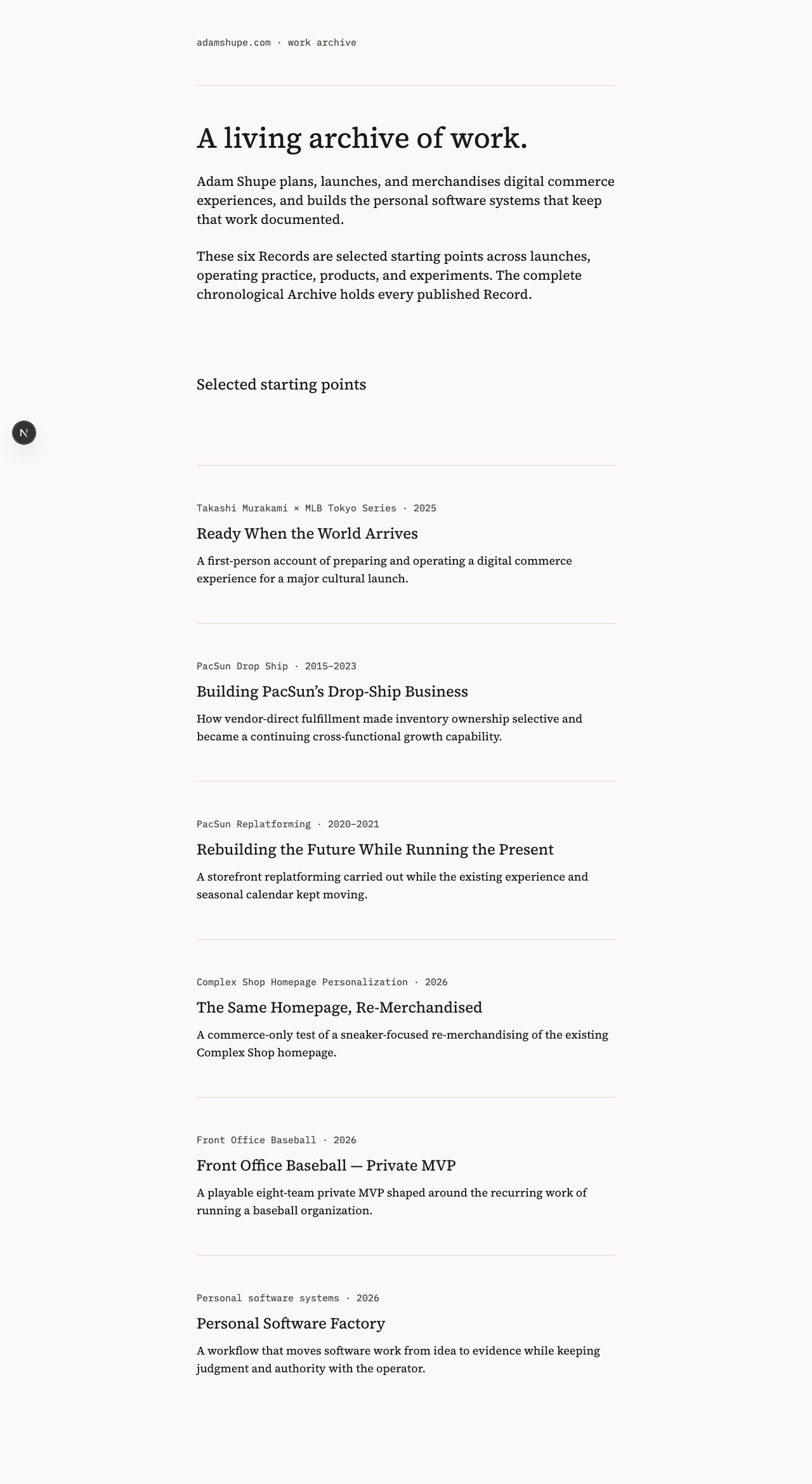
Current curated Home — a selective six-Record introduction with a direct path to the complete Archive.
Capture provenance — current local repository rendering of https://adamshupe.com/, captured by Adam Shupe with Playwright CLI on August 24, 2026. It does not establish that the six Records are best, reader-tested, or the complete archive.

Current complete Archive — nineteen Published Records in chronology, with four overlapping orientation lenses visible.
Capture provenance — current local repository rendering of https://adamshupe.com/archive, captured by Adam Shupe with Playwright CLI on August 24, 2026. It does not establish reader outcomes, a universal taxonomy, semantic causality, private-archive completeness, or final architecture.
Within Archive, four overlapping lenses—launches and customer experiences, programs and operating practices, products and platforms, and experiments and optimization—named recurring modes of work. They offered recognition rather than a classification system: a Record could appear in more than one, and the full chronology always remained visible.
At the end of every public Record, I chose the same basic way forward: the complete Archive and the immediate newer or older neighbor. That made each Record a continuation point while keeping chronology honest: adjacent meant nearby in time, not related in subject.
Representative public Record foot — continuation, one approved relationship, and the Archive keeper remain visibly distinct.
Capture provenance — current local repository rendering of https://adamshupe.com/records/adamshupe-com-stage-1-public-v1, captured by Adam Shupe with Playwright CLI on August 24, 2026. Presentation-only: one foot does not prove every Record renders a relationship or that chronology itself is a relationship.
Thematic relationships faced a higher bar. Shared employers, names, themes, or dates could not create a connection on their own. I approved four specific relationships to appear in five places and left everything else out. I treated Evidence with the same restraint: preserve where it came from and what it could support, then use it for a specific narrative purpose rather than turning it into a public inventory or a measure of importance.
Together, these choices gave the archive enough orientation without hiding it behind machinery. I stopped before search, filters, deep taxonomy, or a relationship graph could become projects of their own.
One richer Record
Only after the archive-wide foundation and reader journey were in place did I approve one richer Record experiment. An existing Record became a deliberately limited test of whether stronger composition could clarify its argument without rewriting the story or disturbing the archive around it.
The point was not to retell the underlying project or declare a new template. It was to learn whether one Record could carry a more specific visual and editorial rhythm without weakening the common grammar that kept nineteen unlike subjects legible together.
The pilot succeeded on those terms and produced useful lessons about hierarchy, Evidence, rhythm, and responsive simplification. Its exact composition remained local to that Record. One richer expression showed that the foundation could support variation; it did not establish that every existing or future Record needed the same treatment.
Leave the next redesign separate
I stopped after one richer pilot because I have longer-term plans for a deeper redesign. The pilot showed that a Record could take on a more specific expression, but it did not make a case for retrofitting nineteen stories. I kept its lessons as options and left the larger redesign to earn its own scope later.
A successful experiment can easily become a rollout. I chose not to do that. The archive could hold one local exception without turning it into a template, and production no longer needed to wait.
My judgment is that the work improved consistency and chronological storytelling across the archive. That is my assessment, not a measured claim about reader comprehension, traffic, engagement, or any external result. The clearer chronology and distinct paths through the work make the basis of that judgment visible without proving an audience outcome.
With those decisions in place, the archive was coherent enough to continue growing. It was not finished, and deeper redesign remained separate. I resumed significance-first production: the next task was not to perfect the container, but to add the next story worth preserving.