Independent · Software
Front Office Baseball — Private MVP
How years of baseball-simulation opinions became my first playable software product, built by directing AI implementation around the work of running a baseball organization.
- Owned
- Conceived, product-directed, and game-designed Front Office Baseball; AI/LLM coding systems generated the implementation under his direction
Approximately April 2026–August 13, 2026 · playable private MVP in active development and live playtesting
Chronicle
Why build a baseball game
I had spent years with sports-management simulations — Out of the Park Baseball, Basketball GM, games in the ZenGM family. What I took from them was personal rather than a verdict on any of them: a browser-native baseball game could do more with the structure that makes running a baseball organization distinct.
I wanted the decisions to start where my thinking about baseball already started — organizations, pipelines, a season with its own rhythm, roster choices whose value unfolds across years — rather than from a general management system with baseball names on it.
Front Office Baseball is the first game under The Commissioner's Office, the umbrella I intend for sports-simulation games. So far that umbrella covers one real game.
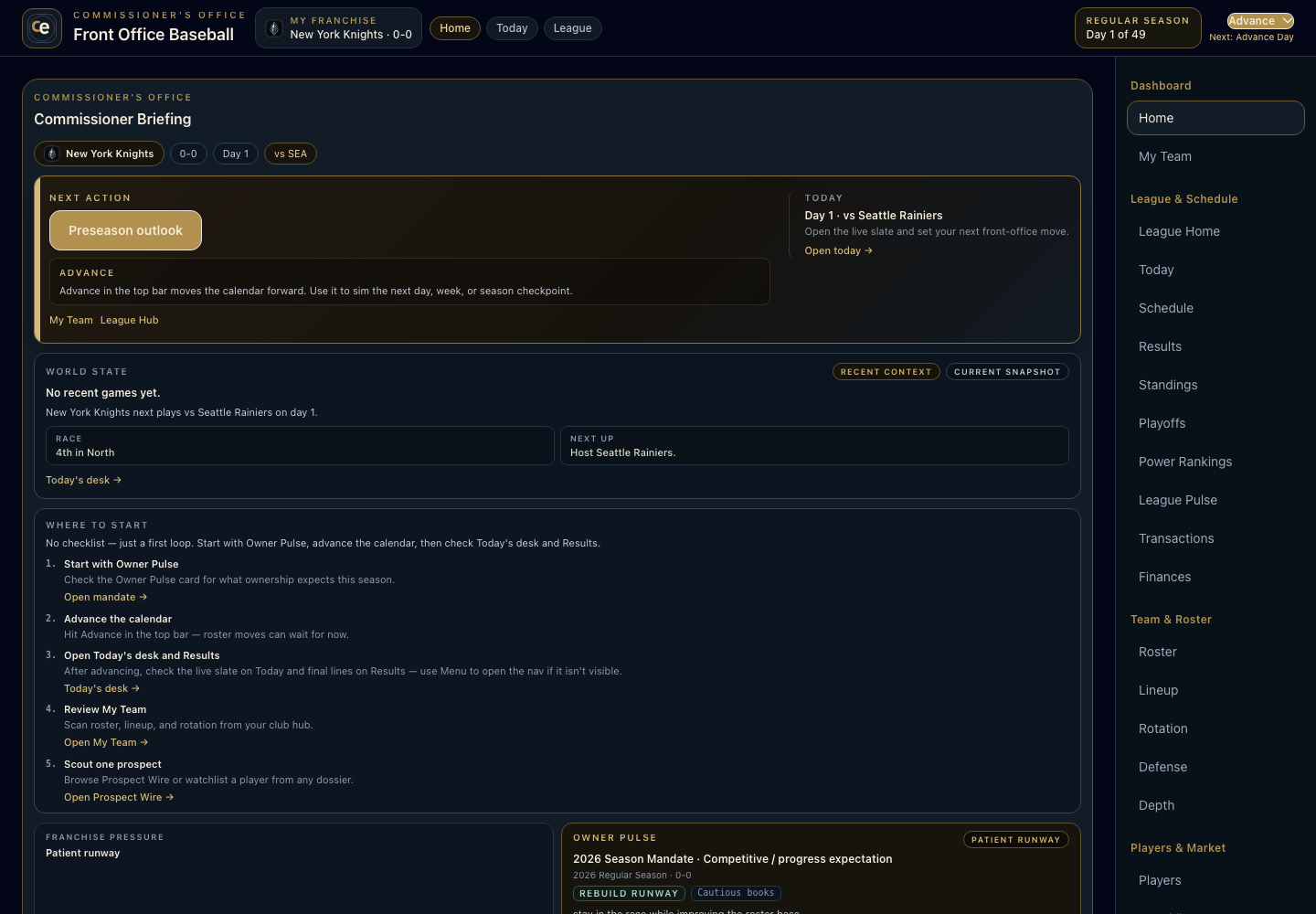
Home Command Center — fresh capture from the playable Front Office Baseball Private MVP.
Provenance — governed capture of the fictional Front Office Baseball Private MVP; not public-release, adoption, retention, or performance evidence.
Make baseball feel like baseball
The organization came before the feature list. Prospects and farm-system thinking had to matter because a front office manages more than the roster visible at the top level.
The calendar had to carry baseball's structure too. I put the amateur draft in the middle of the season, treated international amateur signings as a meaningful path into the organization, and designed contracts and careers around baseball-specific patterns rather than generic negotiation.
Together they gave me a test for the product: does this decision feel like work that belongs to running a baseball organization?
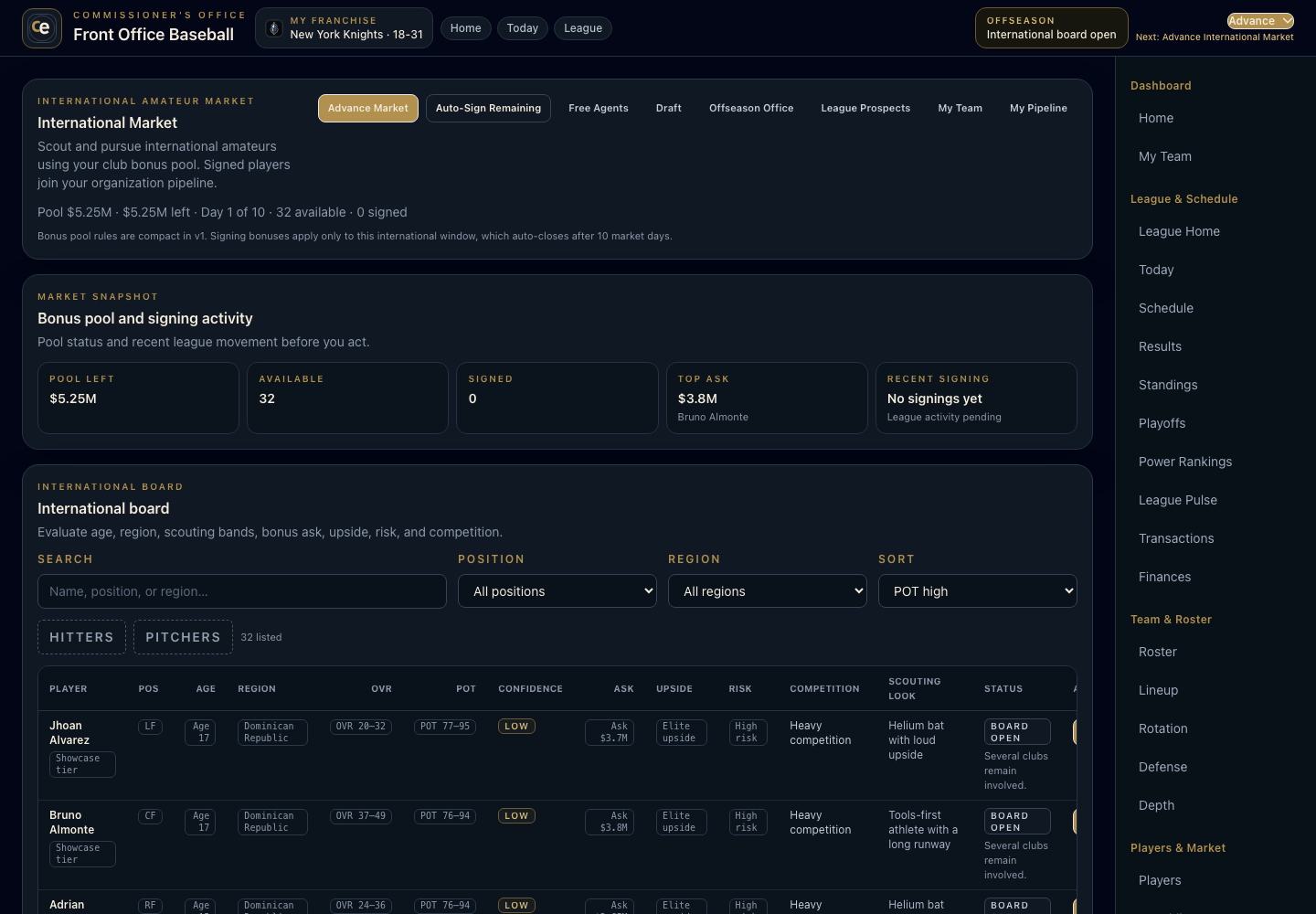
International Amateur Market — fresh capture of the fictional international amateur acquisition system.
Provenance — governed capture of a fictional private-MVP system; not public-release or adoption evidence.
Beginning around April 15, 2026 — direct the first build
Development began around April 15, 2026. It was my first practical experience building software, and I was not hand-writing the codebase as a traditional engineer.
I conceived the product, supplied the baseball judgment, made the game and product decisions, set scope and priorities, specified and reviewed the work, evaluated what came back, and decided what stayed, changed, or was cut. AI/LLM coding systems generated the implementation under my direction. The code came from the systems; the product came from the sustained choices required to turn what I meant into something that worked.
The loop becomes the game
The game became real when its recurring loop held together. A season could progress through the mid-season draft, awards, postseason, and offseason, then return to roster building and another season.
Transactions, trades, and international amateur signings were not isolated demonstrations. They became ways to change an organization and live with those decisions as the calendar moved forward.
That continuation is the game. The milestone was not that one screen or mechanic worked; it was that I could run a team through the cycle and keep playing.
Cut the field
I kept trying to make the Depth Chart page show a full baseball field. It was an obvious visual idea, and one I knew from other baseball games. The result kept looking poor.
After repeated attempts I cut the field visualization. The need to understand a depth chart did not go away; one familiar expression of it had not earned its place at the quality I could reach.
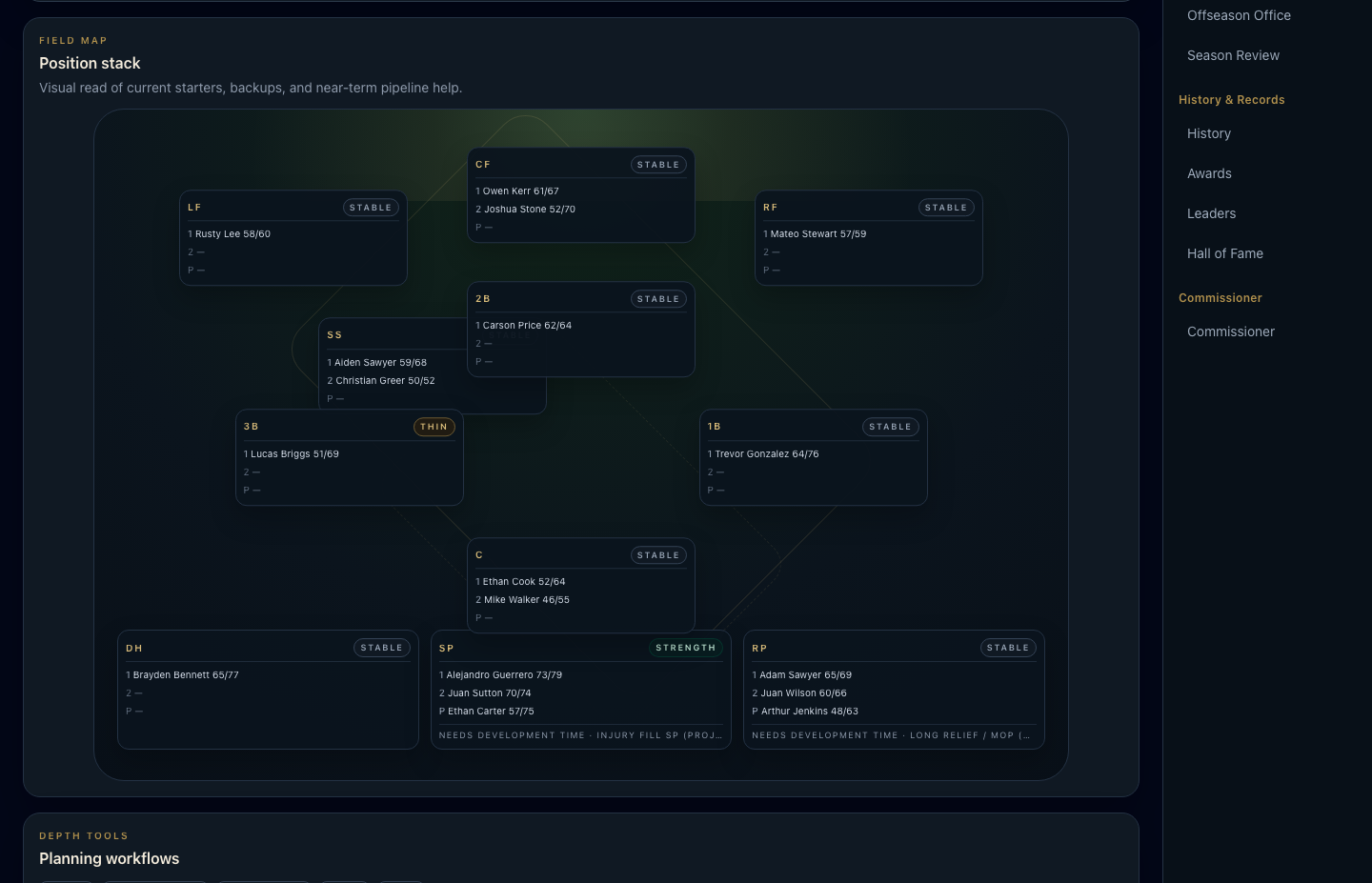
Depth Field Map — fresh capture of the current surviving depth-map expression. It does not depict the removed failed field visualization.
Provenance — governed capture of the current fictional depth-map expression; not the removed failed visualization or public-release evidence.
August 13, 2026 — a private MVP
The private MVP has eight teams and a 49-game schedule, not 30 teams and a 162-game season. That smaller scale is what let the complete season and front-office loop become playable at all. Complete here describes the loop at its current scale, not the eventual product, and the larger numbers are a boundary I can name rather than an announcement or a roadmap commitment.
By August 13, 2026, Front Office Baseball was a playable private MVP in active development and live playtesting. I cannot point to the day the MVP became complete or the day live playtesting began. What comes next is more live play — more players, more feedback — to show what should improve and what deserves a place on the roadmap. That is a testing posture, not a launch.
Building the game also showed me how easily AI-directed work drifts and loses its source of truth. The earliest Personal Software Factory grew out of that problem, as ticket tracking and receipts for when, why, and how changes were made; that system has its own story, and it is supporting context here.
Underneath all of it is a simpler fact: a baseball thesis I had carried for years had become a game other people could play and help me improve.